
Personal Finance Essentials
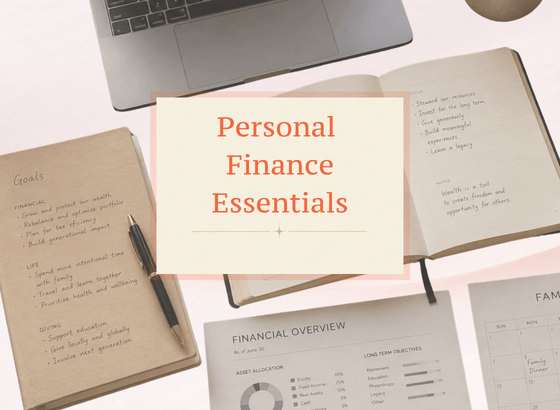
How do I build a financial plan and budget that reflects the realities of wealth?
Personal Finance Essentials (formerly Personal Finance Fundamentals Module 1) introduces personal finance through the specific context of wealth, where familiar concepts like saving, spending, budgeting, and planning become more complex and consequential. Learners explore how money can serve as “rocket fuel” for flourishing when aligned with values, purpose, relationships, and long-term goals. Through financial planning exercises, case studies, and practical tools, the module helps participants evaluate income, spending, saving, risk, charitable giving, and capital sufficiency with greater intention. The focus is not on basic financial literacy alone, but on building the judgment, language, and self-awareness needed to steward resources thoughtfully and engage more effectively with advisors and in family decision-making.
What You’ll Be Able to Do on the Other Side
- Clarify how financial resources can support or undermine personal flourishing, purpose, and responsible stewardship.
- Use the Five Capitals Framework to evaluate wealth beyond financial capital, including human, learning, social, legacy, and financial well-being.
- Prioritize financial goals by distinguishing between needs, wants, and wishes in light of your own circumstances, values, and time horizon.
- Organize income, spending, saving, and budgeting information to make more intentional financial decisions and prepare for advisor conversations.
- Evaluate trade-offs among savings strategies, passive income opportunities, risk management tools, capital sufficiency, and charitable giving options.
The Experience
This self-paced module combines reflection, practical worksheets, case studies, calculators, and curated podcasts to help learners apply personal finance fundamentals in the context of wealth. Learners engage with the Five Capitals Assessment, financial visioning exercises, needs-wants-wishes categorization, goal-mapping activities, and budgeting tools, including a Basic Budget Review Sheet and Annual Budget Review Sheet. These resources help participants connect income, spending, saving, risk, giving, and long-term planning to their values, priorities, and responsibilities.
The experience emphasizes application rather than technical mastery. Through a financial planning exercise, family wealth case studies, charitable giving decision case study, and featured resources on succession, wealth dynamics in friendships, insurance planning, capital sufficiency, and impact giving, learners practice moving from ideas to analysis. Calculators for retirement and education goals support practical estimation, while the podcast examples broaden the conversation to include family complexity, stewardship, risk, philanthropy, and advisor readiness.
Program Outline

Personal Finance Fundamentals
Personal Finance Fundamentals covers the basics of practical financial skills starting with financial planning, risk management, and personal budgeting. The course moves on to corporate financial statements and builds up to analyzing key performance measures and ratios. This course also covers how to read core financial statements including a balance sheet, cashflow statement, and income statement. Finally, learners will apply knowledge through an in-depth case study that encourages critical thinking and problem-solving to make complex financial decisions.
Pricing
- Access your courses anytime, anywhere, with a computer, tablet or smartphone
- Videos, quizzes and interactive content designed for a proven learning experience
- Unlimited access. Take your courses at your time and pace
- This program is designed to take 1-2 months with approximately 10-15 hours per week of study. If you put in more hours per week, you will finish sooner than the predicted 1-2 months
-
Share This Learning Path
